Vehicle manufacturers have created a rigged market. They restrict independent repair shops from accessing the same diagnostic data and software tools they freely provide to authorized dealerships. The result is artificial scarcity, inflated costs, and the slow strangulation of a sector that employs millions of Americans and millions more in Louisiana specifically.
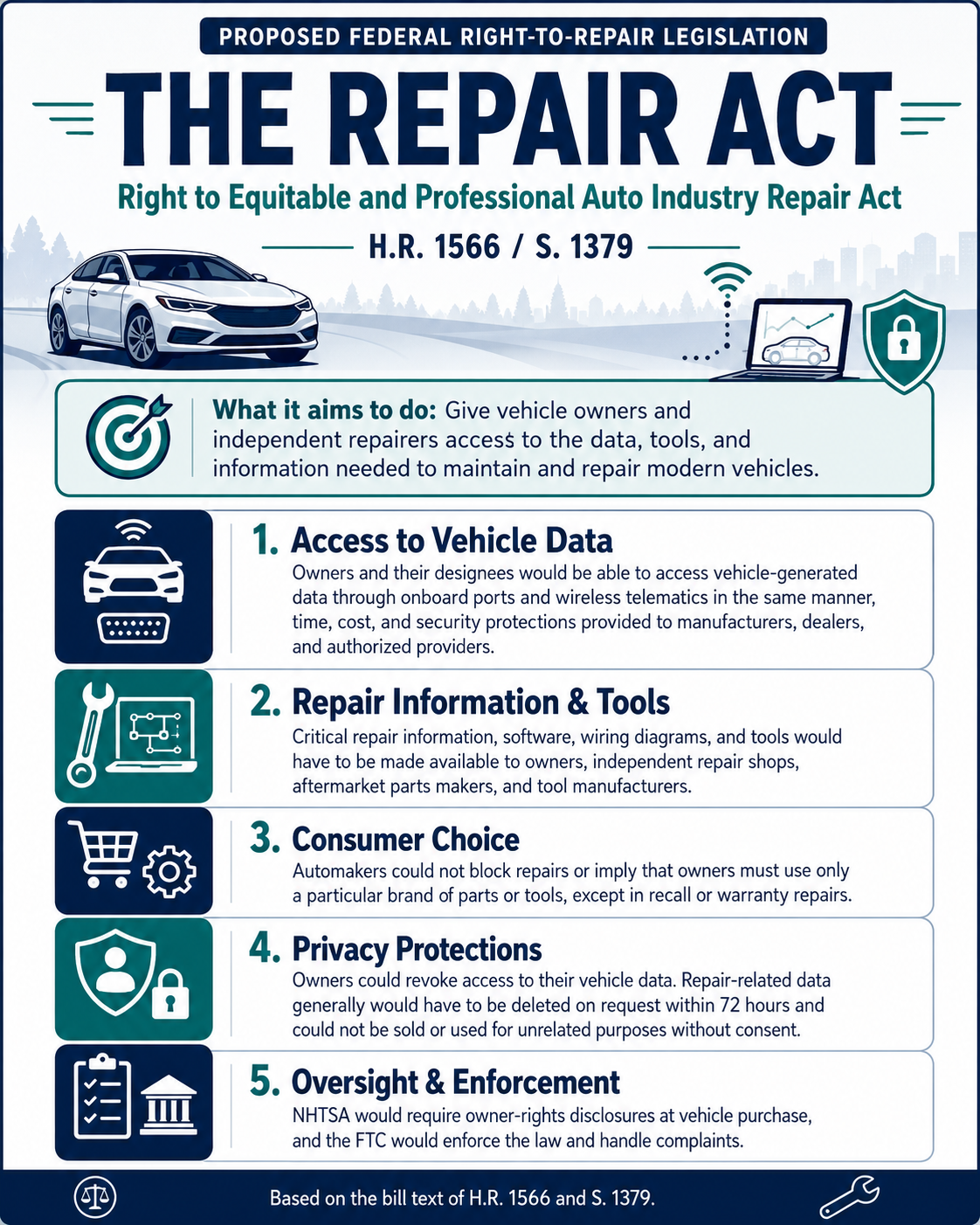
This is the problem the REPAIR Act addresses. The legislation, H.R. 1566 in the House and S. 1379 in the Senate, would require manufacturers to provide independent repair shops the same data access they currently give to dealerships. That's it. No special privileges. No advantages. Just equal access to the same information.
The stakes for Louisiana are substantial. Sixty-three percent of independent repair shops already report difficulty making routine repairs on a daily or weekly basis due to manufacturer data restrictions. In rural parishes where dealerships are often sixty or eighty miles away, this is not an inconvenience. It is a barrier to basic vehicle maintenance. Farmers and rural families cannot drive two hours for routine service. They depend on the local mechanic. When that mechanic cannot access the repair data he needs, the entire rural economy suffers.
The numbers are stark. Independent repair shops charge thirty-six percent less on average than dealerships. The cost impact without the REPAIR Act is projected at thirty-four billion dollars annually across the country. The average American family will face an additional $185 to $225 in annual vehicle repair costs. Over a decade, that is thousands of dollars. For independent aftermarket businesses, the picture is worse. Market share will collapse from 55% today to 30% by 2035 without legislative action. Four million American jobs in the vehicle supplier industry are at risk. 82,500 independent repair shops, employing 345,600 workers, will be devastated.
Louisiana's agricultural economy depends on these shops. Rural hospitals and emergency services depend on families being able to keep their vehicles maintained affordably. Small towns depend on the jobs these businesses provide.
The core principle at stake is whether we allow competitive markets or accept manufactured monopolies. When a single player can lock out competitors through data restriction rather than superior service or pricing, competition ceases to exist. The REPAIR Act restores it.
The bill has already advanced out of the House Energy and Commerce Subcommittee on Commerce, Manufacturing, and Trade. It carries bipartisan support, and polling has shown that an overwhelming number of Americans back the bill. The Trump Administration has committed to lowering costs and protecting American jobs. This legislation accomplishes both objectives.
Speaker Johnson and Majority Leader Scalise have the opportunity to bring this bill to the floor and advance it. Louisiana's rural communities, Louisiana's agricultural economy, and Louisiana's independent businesses depend on it. The REPAIR Act deserves a vote.