Posts filed under Oil and Gas

Hurricane Isaias Shuts Nearly Two-Thirds of Gulf Oil Output, Putting Louisiana's Offshore Energy Network on Alert

Hurricane Isaias is disrupting Gulf of Mexico energy production on a scale that reaches directly into Louisiana’s offshore economy, even as the storm’s forecast landfall has shifted east of the state.

Federal offshore data reported Thursday showed approximately 62.9 percent of Gulf oil production - roughly 1.28 million barrels per day - shut in as operators evacuated personnel and secured platforms ahead of the storm. About 121 production platforms and five drilling rigs had been evacuated.

BP, Shell and Chevron are among the companies that have curtailed operations. Shell shut production at several major deepwater assets, while Chevron began shutting in four operated facilities. BP reduced production and removed personnel from facilities including Na Kika and Thunder Horse.

Louisiana's Exposure Extends Beyond Landfall

The storm is expected to make landfall near the Alabama-Florida border, but Louisiana’s economic exposure to Gulf hurricanes is not limited to where the eye crosses the coast.

Offshore production, helicopter operations, supply vessels, Port Fourchon activity, pipelines and refineries form an interconnected energy system. A storm crossing major offshore fields can interrupt production even when Louisiana avoids the strongest onshore winds.

That matters to the state’s energy-service companies and workers, particularly in south Louisiana communities that support offshore operations.

Temporary Shutdown or Longer Disruption?

Pre-storm production shut-ins are standard safety measures and do not by themselves indicate physical damage. Operators typically begin restarting platforms after a storm once personnel can return and inspections confirm that facilities, pipelines and subsea systems are safe.

The duration of Isaias-related losses will therefore depend heavily on what damage, if any, is found after the storm passes.

Reuters reported Thursday that more than 60 percent of Gulf oil production had been halted as the storm strengthened. The storm also disrupted natural-gas production and prompted extensive evacuations.

What to Watch Next

The next important numbers will be the post-storm offshore production reports and damage assessments. A rapid restart would make the disruption primarily a short-term production loss. Damage to platforms, pipelines, ports or refining infrastructure could extend the economic impact.

For Louisiana, the episode is another reminder that Gulf energy remains both a major economic asset and an industry whose operations can be altered quickly by tropical weather.

Source Notes

Reuters, Oct. 8, 2026 - Gulf production disruptions: https://www.reuters.com/business/environment/hurricane-isaias-strengthens-us-gulf-coast-prepares-landfall-2026-10-08/

Reuters, Oct. 8, 2026 - Shell and Chevron offshore actions: https://www.reuters.com/business/energy/shell-chevron-cut-gulf-mexico-output-tropical-storm-isaias-approaches-2026-10-08/

Posted on October 9, 2026 and filed under Oil and Gas.

EPA Moves Blue Marlin Offshore Oil Port Toward Permitting, Opening Cameron Parish Hearing and Comment Period

A proposed offshore crude-oil export terminal off Cameron Parish has cleared another federal permitting milestone, with the U.S. Environmental Protection Agency proposing two Clean Air Act permits for the Blue Marlin Offshore Port.

EPA announced October 1 that it is proposing a Prevention of Significant Deterioration preconstruction permit and a Title V operating permit for the project. The agency has opened a public-comment period through October 29 and scheduled an in-person hearing that evening in Cameron.

The proposed permits are not final approval to build or operate the entire project. EPA’s action covers air emissions, while Blue Marlin still requires approvals through the broader federal deepwater-port licensing process.

A Nearly Two-Million-Barrel-a-Day Export Concept

EPA says the project would modify an existing offshore platform in federal waters approximately 82 statute miles off Cameron Parish and allow direct loading of Very Large Crude Carriers and smaller tankers.

The proposed system is designed to move crude at up to 80,000 barrels per hour — approximately 1.92 million barrels per day at that maximum rate. EPA’s October 1 announcement described potential annual exports of roughly 605 million barrels.

Crude would originate at Energy Transfer’s Nederland Terminal in Jefferson County, Texas, travel through a new 42-inch pipeline and then use the existing 36-inch Stingray Mainline to reach the offshore platform complex.

Reusing Gulf Infrastructure

Blue Marlin’s project plan relies partly on repurposing existing offshore natural-gas infrastructure rather than constructing an entirely new offshore corridor. The company says direct offshore loading would allow large crude carriers to take on full cargoes without relying on smaller vessels to shuttle oil to ships anchored farther offshore.

EPA says the proposed air permits would require vapor-capture technology, including a dedicated collection system and combustion units. The agency expects the system described in the permit record to capture approximately 99 percent of vapors associated with transfer and loading operations.

That figure is a permit-design expectation, not a measured operating result because the facility has not been built and placed into service.

Public Hearing Set for Cameron

EPA will hold a public hearing from 6 p.m. to 8 p.m. on October 29 at the Cameron Parish Police Jury West Annex, 148 Smith Circle in Cameron. Written comments are also due October 29 under EPA docket EPA-R06-OAR-2026-1323.

After the comment period closes, EPA must consider significant comments before deciding whether to issue, modify or deny the air permits.

Another Major Project in Southwest Louisiana’s Energy Corridor

Cameron Parish is already central to Louisiana’s LNG expansion, pipeline construction and Gulf Coast energy infrastructure. Blue Marlin would add a different piece of the export chain: a large offshore terminal designed around crude oil rather than LNG.

The project still has regulatory steps ahead, and EPA’s proposed permits should not be confused with final authorization. But moving the air permits into public review is a concrete step toward a federal decision on whether the offshore terminal can advance.

For Cameron Parish residents and Louisiana’s energy industry, October 29 is now the next important date.

Source Notes

U.S. Environmental Protection Agency, Oct. 1, 2026: https://www.epa.gov/newsreleases/epa-proposes-action-unleash-american-energy-gulf-america

EPA Blue Marlin public notice and permit docket: https://www.epa.gov/caa-permitting/public-comment-and-hearing-opportunity-blue-marlin-offshore-port-llc-bmop-deepwater

Blue Marlin Offshore Port project information: https://bluemarlinport.com/the-project/

Posted on October 2, 2026 and filed under Cameron Parish, Louisiana, Oil and Gas.

Plaquemines LNG Asks FERC to Put Phase 1 Into Service, Clearing Final Regulatory Step Before Commercial Operations

One of Louisiana’s largest LNG export projects is approaching the transition from commissioning to commercial operation.

Venture Global asked the Federal Energy Regulatory Commission on October 1 for authorization to place all of Phase 1 of its Plaquemines LNG terminal into service. Reuters reported that the company told FERC its commissioning operations had been successful and requested permission to move the phase into service.

The request is significant because FERC approval would allow Venture Global to begin commercial deliveries from Phase 1 to long-term customers, including Shell.

From Commissioning Cargoes to Long-Term Contracts

Plaquemines LNG has already been producing and exporting LNG during commissioning. Commercial operation is different: it marks the point when contracted customers begin receiving cargoes under long-term agreements rather than the developer retaining flexibility to sell commissioning cargoes into the spot market.

Venture Global has previously said it expects commercial operations for Phase 1 to begin by October 31.

The company’s regulatory request does not itself constitute FERC approval. The federal commission must still authorize the facilities to be placed into service.

A Major Piece of Louisiana’s LNG Buildout

The Plaquemines project sits on approximately 630 acres along the Mississippi River in Plaquemines Parish. Company filings describe Phase 1 as having 13.3 million metric tons per year of nameplate capacity, with Phase 2 adding another 6.7 million metric tons per year.

Venture Global has also proposed a separate expansion immediately adjacent to the existing terminal. FERC says that proposed expansion would add up to approximately 18.6 million metric tons per year through 12 additional liquefaction blocks, another marine berth and associated power-generation facilities. That expansion remains under federal review and has not been approved.

Why Commercial Service Matters

Louisiana’s LNG industry has spent years moving projects through financing, construction and federal permitting. The Plaquemines filing is a different kind of milestone: a large facility that is already producing LNG is seeking the authorization that converts a major portion of the plant into regular commercial service.

That transition matters to customers, investors and Louisiana’s natural-gas market. Large LNG terminals create sustained demand for Gulf Coast gas and support pipelines, marine services and industrial work across the region.

It also comes during a period of elevated global LNG prices. Reuters reported that European and Asian benchmark LNG prices averaged above $25 per million British thermal units in September, while Venture Global has benefited from spot-market sales during commissioning.

The next development to watch is FERC’s response. If the agency grants the request, Phase 1 of Plaquemines LNG will move from startup operations into the commercial phase Venture Global has been building toward for years.

Source Notes

Reuters, Oct. 1, 2026: https://www.reuters.com/business/energy/venture-global-asks-federal-regulators-place-service-its-plaquemines-lng-plant-2026-10-01/

Federal Energy Regulatory Commission — Plaquemines LNG Expansion Project: https://www.ferc.gov/plaquemines-lng-expansion-project

Venture Global SEC project description: https://www.sec.gov/Archives/edgar/data/2007855/000119312525012218/d146310d424b4.htm

Posted on October 2, 2026 and filed under Louisiana, Oil and Gas.

Port Fourchon LNG Project Takes a Major Engineering Step Toward a 25-Million-Ton Export Facility

A proposed liquefied natural gas export terminal at Port Fourchon moved into a more detailed engineering phase Monday, giving one of South Louisiana's largest proposed energy projects a new milestone to clear on the road toward construction.

Tecnimont USA, part of Italy-based MAIRE, signed a front-end engineering design contract with Argent LNG for the planned export facility at Port Fourchon. The contract follows a preliminary cooperation agreement announced in January and will now move the project into detailed technical definition while supporting its federal permitting process.

What the FEED Contract Actually Does

Front-end engineering design, commonly called FEED, is the stage where a major industrial project develops the engineering detail needed to establish scope, cost, schedule, safety requirements and execution plans before a final investment decision.

MAIRE says Tecnimont's work will include project-execution planning, cost and schedule estimates, safety and reliability studies, integration of major technology packages and technical support for the Federal Energy Regulatory Commission permitting process.

The companies say the proposed terminal is designed for total capacity of 25 million metric tons of LNG per year. Argent LNG is targeting first cargo in 2030.

Still a Development Project - Not Yet a Construction Decision

The new contract is a meaningful development milestone, but it should not be confused with a final authorization to build the terminal.

MAIRE says the project would move into engineering, procurement and construction only after FEED is completed, the FERC process is finalized and Argent LNG makes a final investment decision. Those are significant remaining steps involving permitting, commercial agreements, financing and project economics.

Why Port Fourchon Matters

Port Fourchon is best known as the service base for the deepwater Gulf of Mexico energy industry. An LNG export facility would broaden the port's role in the global energy trade while adding another major proposed project to Louisiana's expanding LNG corridor.

For South Louisiana contractors, fabricators and industrial workers, the most important milestone will be a final investment decision that converts engineering work into construction. Monday's FEED contract does not get the project there yet, but it moves Argent LNG another step closer to the point where that decision can be made.

Source Notes

MAIRE/Tecnimont press release, Sept. 28, 2026: https://www.groupmaire.com/en/newsroom/press-releases/detail/tecnimont-maire-signs-front-end-engineering-design-contract-including-support-to-the-permitting-process-for-argent-lngs-export-facility-in-louisiana-usa-following-the-agreement-previously-announced-in-january/

Tecnimont initial project agreement, Jan. 21, 2026: https://www.tecnimont.com/en/newsroom/news/tecnimont-enters-the-lng-market-through-a-strategic-agreement-with-argent-lng-in-the-usa-for-the-development-of-an-lng-export-facility-in-louisiana/

Posted on September 29, 2026 and filed under Louisiana, Oil and Gas.

Cheniere's $6 Billion Cameron Parish LNG Expansion Moves Closer to a $138 Million Property-Tax Break

A $6 billion expansion of Cheniere Energy's Sabine Pass LNG complex in Cameron Parish is one approval away from receiving an estimated $138 million local property-tax exemption over five years under Louisiana's Industrial Tax Exemption Program.

The Louisiana Board of Commerce and Industry approved the project's mega-project status application last week. The application now requires approval from Gov. Jeff Landry before the enhanced exemption can take effect.

What the Incentive Would Change

According to Louisiana Economic Development calculations reported by the Louisiana Illuminator, Cheniere would pay approximately $10.5 million per year in property taxes under the proposed exemption instead of about $29.8 million annually. The difference is roughly $19.3 million per year, producing an estimated $138 million exemption over the applicable period when the program's structure is taken into account.

The mega-project provision allows qualifying investments to seek exemptions of between 93 percent and 100 percent of eligible local property taxes. Under the current rules, a project generally must involve more than $500 million of investment or exceed 200 percent of the parish's average business investment over a 10-year period.

A Bigger Sabine Pass Footprint

Cheniere's Sabine Pass operation is already one of the most important LNG export facilities on the Gulf Coast. The proposed $6 billion expansion would add to an energy corridor where billions of dollars in LNG, pipeline and storage projects are either operating, under construction or moving through development.

For Cameron Parish, the debate around an incentive of this size involves two competing considerations: attracting and expanding capital-intensive industry while preserving the local property-tax base that supports public services.

The Board's vote does not end that debate, and it does not make the tax exemption final. The governor's approval is still required.

Disclosure

Gov. Jeff Landry is a current advertiser with Cajun Conservatism. That advertising relationship had no role in the selection or factual treatment of this story. The article reports the incentive as pending rather than approved because gubernatorial action remains outstanding.

Source Notes

Louisiana Illuminator, Sept. 28, 2026: https://lailluminator.com/2026/09/28/itep-cheniere/

10/12 Industry Report summary, Sept. 28, 2026: https://www.1012industryreport.com/oil-gas/lng/cheniere-energy-eyes-138m-tax-break-in-cameron-parish/

Posted on September 29, 2026 and filed under Louisiana, Oil and Gas.

Do We Want a Trial Lawyer Economy or a REAL Economy?

Louisiana’s future depends on the choices we make now: do we want a trial lawyer economy or a REAL economy?

In this conversation with Moon Griffon, Grow Louisiana Coalition Executive Director Marc Ehrhardt discusses the growing impact of coastal lawsuits on Louisiana’s economy, business climate, and long-term investment outlook.

As Marc explains, companies looking to invest want certainty, but endless litigation creates an environment that pushes opportunity elsewhere.

Posted on June 11, 2026 and filed under Louisiana, Oil and Gas.

The Narrative Cracks: Anti-Carbon Capture Groups Deny Soros Ties as Funding Tells a Different Story

Over the past several years, a network of environmental groups working in Louisiana has helped drive opposition to oil and gas development, industrial expansion, and carbon capture projects across the state.

Many of those same groups are connected, directly or indirectly, to a national funding pipeline backed by George Soros and his affiliated organizations.

At the same time, activists at the center of Louisiana’s anti-carbon capture campaigns have repeatedly denied any connection to that network, dismissing such claims as false or misleading.

But a closer look at publicly available data tells a more complicated story.

Since 2019, Soros and his affiliated donor network, including the Open Society Foundations and the Tides Foundation, have directed at least $18.5 million into environmental organizations operating in Louisiana. These funds have supported a range of advocacy efforts aimed at opposing energy development in the state, including the expansion of carbon capture infrastructure.

While activists often point to the absence of direct checks from Soros himself, that framing ignores how modern advocacy networks operate. Funding rarely moves in a straight line. Instead, it flows through interconnected national and regional organizations that provide resources, staffing, legal support, and strategic coordination to local groups.

In Louisiana, that network is extensive.

Organizations such as Step Up Louisiana and Rise St. James have received funding tied to these national pipelines, either directly or through fiscal sponsors aligned with the same donor ecosystem. At the same time, national groups with an established presence in Louisiana, like the Sierra Club and Earthjustice, have collectively taken in more than $14 million from those same sources since 2019.

These organizations are not passive participants. They play a central role in shaping the anti-carbon capture campaign—bringing legal challenges, organizing opposition, and amplifying messaging across the state. In some cases, national groups have directly coordinated with Louisiana-based activists on efforts to block energy projects, further blurring the line between local advocacy and national strategy.

Taken together, the pattern is difficult to ignore.

What is presented publicly as a decentralized, grassroots resistance begins to look more like a coordinated campaign supported by a well-funded network with national reach. That distinction matters—not just for the sake of transparency, but for understanding what is truly driving the debate over carbon capture in Louisiana.

The stakes are significant. As global markets and domestic policy increasingly prioritize lower-carbon production, carbon capture is emerging as a key factor in determining where industrial investment flows. For a state like Louisiana, whose economy is deeply tied to energy, manufacturing, and exports, the ability to deploy that technology could shape its economic trajectory for decades.

Opposition groups are entitled to challenge those projects. But the argument changes when the movement is framed as purely local while drawing support from millions of dollars in national funding tied to George Soros and his broader network.

Posted on May 4, 2026 and filed under Louisiana, Oil and Gas, Energy.

Louisiana Lawsuit Abuse Watch Responds to Today's Chevron vs. Plaquemines Parish SCOTUS Decision

BATON ROUGE, LA - In a unanimous decision announced today, the U.S. Supreme Court vacated a lower court ruling and held that this lawsuit will be moved from state to federal court, under the federal officer removal statute.

LLAW Executive Director Lana Venable had the following comment:
"The U.S. Supreme Court made the right decision for Louisiana today. These lawsuits - ongoing for over a decade - represent what is wrong with our state's legal system. This decision is a victory for hardworking Louisianans who want fairness and predictability, not for trial lawyers looking to cash in at the expense of the economic engine that drives Louisiana."


###

About Louisiana Lawsuit Abuse Watch (LLAW)
Louisiana Lawsuit Abuse Watch (LLAW) is a high-impact watchdog group with nearly 20,000 supporters across the state dedicated to fixing Louisiana's broken legal system through transparency, accountability, and lawsuit reform.

Posted on April 17, 2026 and filed under Louisiana, Oil and Gas.

LOGA Responds to Supreme Court’s Decision to Move Plaquemines Parish Coastal Lawsuit to Federal Court

BATON ROUGE, LA (April 17, 2026) - Today, the United States Supreme Court issued a unanimous 8-0 decision in Chevron USA Inc. v. Plaquemines Parish, Louisiana declaring that the case should be tried in federal court, as opposed to state court.

In response, LOGA President Mike Moncla issued the following statement:

“This is a huge, but incremental win for our industry. For far too long, frivolous lawsuits, whether it be coastal or legacy, have pushed investment out of our state.

Decades ago, the defendants of these lawsuits invested in drilling in our coastal region after the state encouraged, incentivized, and gave permits to do so, all the while the state raked in billions of dollars in severance and royalty collections.

From the time these lawsuits began a decade ago, oil and gas activity in Louisiana’s state leases and inland waters has declined to nearly nothing.

Drilling is nil, production is a shadow of its former self, and service companies have been starved into bankruptcies.

This case is as frivolous as the ones by liberal cities like Baltimore who sue oil and gas for climate change -- while they sit in their air-conditioned offices.

Today’s ruling from the Supreme Court is the first step towards justice.”

Posted on April 17, 2026 and filed under Louisiana, Oil and Gas.

The Radical-Funded Machine Driving Louisiana’s Anti-CCS Campaign

A political fight is unfolding across Louisiana’s energy corridor, but it isn’t the homespun, grassroots uprising its organizers claim. Newly compiled financial records show that more than $50 million in outside money has poured into the activist network campaigning to shut down carbon capture and storage (CCS) projects across the state. Major funders include Michael Bloomberg, Jeff Bezos, George Soros, and the Arabella Advisors network, all of whom bankroll organizations dedicated to phasing out fossil fuels entirely.

The groups leading the anti-CCS push—ranging from the Deep South Center for Environmental Justice to the Louisiana Bucket Brigade, Earthworks, 350.org, and Rise St. James—are heavily financed by national foundations and federal grants. Several operate through fiscal sponsors in California and Washington, D.C., enabling them to present as “local” while masking their donor base and internal finances.

And now, according to public postings and coordination materials, these national organizations are working directly with parish coalitions and landowner groups like Save My Louisiana and the Louisiana CO₂ Alliance. They share the same messaging, graphics, policy demands, and legal strategies—evidence that this isn’t an organic revolt, but a coordinated national campaign using Louisiana as its next battleground.

This network was also reflected in the recent Save My Louisiana lawsuit, which mirrors arguments historically advanced by Earthworks, Sierra Club, and the Bucket Brigade. Their broader policy agenda has already influenced Louisiana’s regulatory climate, including the moratorium on new CCS well applications—an action industry leaders warn is putting the state behind Texas at a pivotal moment.

The stakes for Louisiana’s energy economy are real. CCS is essential for securing billions in new investment, from the proposed Hyundai steel plant to the Meta AI data center, LNG facilities, and next-generation industrial projects. Losing these projects to Texas or Mississippi would mean forfeiting thousands of high-wage jobs and the state’s long-standing leadership in energy production and manufacturing.

Governor Jeff Landry—who has consistently supported responsible CCS development—didn’t mince words when asked about the activist network now influencing local coalitions.

“Leaders of Save My Louisiana have been hoodwinked by the radical left to oppose any new energy development,” Landry told POLITICO’s E&E News. “The men behind that political organization have built their entire careers on the back of the oil and gas industry. They claim to be pro-industry, but they are preventing our state from leading America's energy dominance—and threatening the Louisiana economy and way of life. Sadly, they have been manipulated into becoming the mouthpiece of the well-known anti-oil and gas financiers Mike Bloomberg and George Soros.”

Louisiana isn’t dealing with a spontaneous groundswell of concerned locals. It’s confronting a nationally funded, politically aligned operation working to shut down the very energy projects that underpin the state’s economy, workforce, and future competitiveness. And unless Louisiana reasserts control of its own energy path, those decisions will increasingly be made—not in Baton Rouge—but in the boardrooms of coastal billionaires.

Posted on December 12, 2025 and filed under Oil and Gas, Louisiana.

LOGA Releases Statement on CCUS Moratorium

BATON ROUGE, LA (October 15, 2025) - Today, Governor Jeff Landry issued an Executive Order suspending all new applications for CCUS projects in Louisiana. In response, LOGA President Mike Moncla issued the following statement:

We respectfully disagree with the Governor‘s decision to halt the review of any new CCUS applications.

We are thankful that the Governor didn’t cancel existing CCUS projects, which will continue to prove how safe this technology actually is, and we encourage industry to continue moving forward with the hope that the Governor will lift this moratorium sooner rather than later.

For 75+ years Louisiana’s regulatory arm has safely authorized and governed injection wells. AND for 40+ years through Enhanced Oil Recovery, the Department has safely regulated the injection of CO2. In fact, since 2010, over 47 billion metric tons of CO2 have been safely injected and ultimately stored in Louisiana formations.

Carbon capture is a proven tool that will bring significant economic development and new opportunities to our state and our country, and we remain committed to advancing these benefits for Louisiana.

Posted on October 16, 2025 and filed under Louisiana, Oil and Gas.

ICYMI: Governor Landry Signs Groundbreaking Legislation to Ignite Louisiana’s Energy Industry

BATON ROUGE, LA – Today, Governor Jeff Landry signed into law legislation that will tackle legacy challenges, improve energy affordability, and encourage more oil production.  

Watch the full press conference HERE. 

What Governor Landry Signed: 

SB 244: Sen. Bob Hensgens    

Reorganizes the Department of Energy Natural Resources to make the agency balanced, transparent, and solutions-oriented – including addressing decades of legacy litigation   

Strengthens the rights of Louisiana landowners by limiting expropriation for carbon capture pipelines to companies that operate as common carriers or in situations where it is required solely due to absentee landowners who cannot be located—mirroring the regulatory conditions for petroleum pipelines, ensuring uniformity across Louisiana’s pipeline infrastructure regulations.   

Prevents regulatory overreach at liquid terminals by clarifying the statute regarding pipeline rates and operations at storage or distribution terminals, limiting state oversight scope to ensure predictability and preventing unnecessary litigation.   

Prioritizes water resource management at the state level by transferring oversight of the Capital Area Groundwater Conservation District to the Department of Conservation and Energy, and directing the department to develop a comprehensive water resources management plan to ensure the availability of ground and surface water resources to the public in the face of economic development activities throughout the state.   

Establishes the Natural Resources Commission to promote collaboration among the states resource managers to ensure the protection and availability of the state’s resources for future generations.   

HB 692 Rep. Jacob Landry   

Fortifies Louisiana’s energy future by ordering regulators to prioritize affordable, dependable, in-state dispatchable sources—chiefly natural gas and nuclear—to support grid resilience and shield producers from the cost volatility tied to renewable mandates   

HB 600 Rep. Brett Geymann    

Reduces the severance tax rate on oil produced from newly completed wells after July 1, 2025, and establishes special tax rates for oil produced from limited-production wells, with various certifications and conditions for different well types.   This was a nearly century-old rate of severance tax on oil produced from newly completed wells   

Royalty Executive Order    

Orders the Mineral Board to establish a plan that reduces royalties – helping unleash Louisiana’s coastal energy production   

Posted on June 24, 2025 and filed under Jeff Landry, Louisiana, Oil and Gas.

LOGA Releases Statement on 2025 Legislative Session

BATON ROUGE, LA (June 12, 2025) - Upon the conclusion of the 2025 Louisiana Legislative Session, LOGA President Mike Moncla issued the following statement:

This last week of the session proved to be a big one for prospective oil and gas drilling investments in Louisiana. For decades, Louisiana’s upstream oil and gas sector has been at a competitive disadvantage compared to other producing states with regards to our severance tax rates and legacy lawsuits.

HB 600 by Representative Brett Geymann (Lake Charles) lowered the oil severance tax rate from the nation’s highest, at 12.5%, down to 6.5% for all new drilling projects in Louisiana. Each of the last five years that I’ve been at LOGA, we have attempted to lower the severance rate for oil but fell short on each attempt.

Representative Jacob Landry’s (Erath) legacy lawsuit bill, HB 694 was amended into SB 244 by Senator Bob Hensgens (Abbeville) and was passed on Wednesday. We ran a very similar bill last year that was stalled without even getting a vote on the Senate floor, so we are elated that this legislation made it through the process. While the timeline to implement this new legislation won’t begin until September 2027, this is a long-game play. The clock for a new future has officially started with this legacy reform bill.

We want to thank Governor Landry for keeping his promise on addressing both of these important issues. Also, thanks go out to Speaker DeVillier (Eunice), House Natural Resources Chairman Brett Geymann, Representative Jacob Landry, and Senate Natural Resources Chairman Bob Hensgens. With these positive changes, Louisiana is a more attractive place for oil and gas investment today than it was yesterday.

Posted on June 13, 2025 and filed under Louisiana, Oil and Gas.

Opinion: American Energy Dominance Starts Here at Home. Louisiana Must Lead, Not Litigate.

President Trump’s recent executive order on “Protecting American Energy from State Overreach” sends a clear message: states must stop weaponizing lawsuits against the very industry that powers our nation. This kind of state-led overreach threatens more than just American energy dominance. It jeopardizes our national security, economic prosperity and the livelihoods of working families across the nation.

In Louisiana, we should understand this better than anyone.

Our energy sector drives 25% of the state’s total economic output, contributing nearly $78 billion in value and supporting more than 300,000 of our neighbors through direct, indirect or induced employment. These are well-paid, stable jobs that fuel communities and help keep Louisiana competitive globally.

But this system—our jobs—are under attack from within.

President Trump’s executive order comes on the heels of the troubling coastal lawsuit verdict from Plaquemines Parish, which sent a stark warning that even lawful, permitted energy investments in Louisiana can lead to billion-dollar consequences decades later. And there are still dozens of coastal lawsuits filed in parishes across South Louisiana that are expected to be heard in court soon.

A 2019 study by the Pelican Institute found that these coastal lawsuits are costing Louisiana’s economy up to $113 million annually. That’s money that could be going toward education, infrastructure and local services. They also create a hostile business climate, delaying permitting, discouraging future investment and signaling to energy producers and beyond that Louisiana is a risky, uncertain place to do business.

And we’re not alone. New York’s so-called “climate change” law seeks to collect billions from energy producers for past greenhouse gas emissions, regardless of when or where they occurred. Vermont is pushing similar legislation. California’s aggressive carbon credit regime forces businesses into an impossible bind with harsh emissions caps and costly compliance requirements. Who would have thought Louisiana would be grouped with states known for being anti-industry?

The longer we delay supporting President Trump’s order and prop up the “weaponized” coastal lawsuits in select parishes, the more we risk undermining Louisiana’s position as an energy leader. Louisianians pay the price as jobs move to states like Texas and investments disappear.

Louisiana energy producers are the number one private investors in our coast. We don’t need to sue them into supporting coastal restoration. Every dollar spent on lawsuits is a dollar not spent on restoration. Louisiana works when we work together.

There is a long way to go before the case in Plaquemines Parish is finished. We cannot let what happened there happen in other parishes across South Louisiana. We urge Louisiana’s leaders: comply with the executive order, drop the lawsuits and focus on working with industry to protect our coast, support our jobs and help power the nation.

Energy dominance starts here at home. Louisiana must lead, not litigate.

By Marc Ehrhardt, Executive Director, Grow Louisiana Coalition

Posted on June 12, 2025 and filed under Louisiana, Oil and Gas.

Kennedy in the LOGA Industry Report: GOP mission to clear Biden admin’s red tape will help Louisiana energy producers thrive

“I’m proud that Louisiana will continue to be a leader in oil and gas production as America enters a new era of prosperity and security.”

WASHINGTON – Sen. John Kennedy (R-La.) penned this column for the Louisiana Oil and Gas Association (LOGA) Industry Report explaining how Congressional Republicans are working with the Trump administration to clear red tape to help unleash America’s energy dominance.

Key excerpts of the op-ed are below:

“President Biden let TikTok teens, climate change zealots, and other members of the Democratic Party dictate American energy policy for four years. The results were not good.

“The Biden administration left the American people with 29% higher electricity bills, a depleted strategic national fuel reserve, and a mountain of bureaucratic red tape that made it difficult for energy producers to produce energy and create good-paying jobs. In 2024 alone, Louisiana families had to pay nearly $1,000 more to keep their lights on and gas tanks full.

“Fortunately, the American people voted to restore common sense in Washington. President Trump and my conservative colleagues in Congress are working to restore America’s global energy dominance. To do this, we must first clean up the mess left by the Biden administration — and President Trump and his team are off to a great start.”

. . .

“As common sense makes a comeback in Washington, energy dominance is on the horizon. I’m proud that Louisiana will continue to be a leader in oil and gas production as America enters a new era of prosperity and security.”

Read Kennedy’s column here.  

Posted on June 10, 2025 and filed under Louisiana, Oil and Gas, John Kennedy.

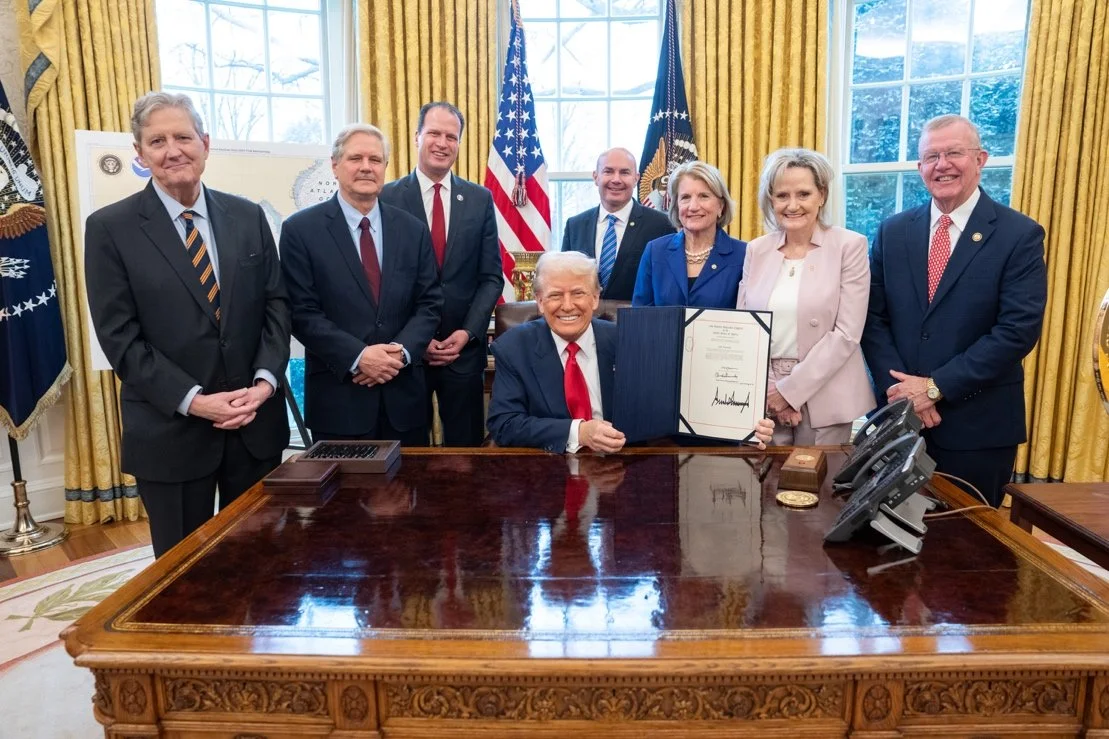
President Trump signs Kennedy resolution repealing rule targeting offshore energy production into law

“Burdensome regulations hurt oil and gas producers’ ability to provide affordable energy and jobs to Americans. I’m thankful to President Trump for taking handcuffs off energy producers by signing my resolution into law.”

MADISONVILLE, La. – President Donald Trump signed Sen. John Kennedy’s (R-La.) Congressional Review Act (CRA) joint resolution of disapproval to reverse the Bureau of Ocean Energy Management’s (BOEM) rule that targeted oil and gas production in the outer continental shelf into law.

“Burdensome regulations hurt oil and gas producers’ ability to provide affordable energy and jobs to Americans. I’m thankful to President Trump for taking handcuffs off energy producers by signing my resolution into law,” said Kennedy.

Sen. Cindy-Hyde Smith (R-Miss.) cosponsored the resolution.

“President Trump promised to restore America’s energy might and by signing these resolutions of disapproval he helps Congress reset policy in a way that encourages offshore oil and gas production. This action also has greater staying power, as any future administration would find it more difficult to reinstate the misguided regulations imposed during the Biden years. I commend President Trump for signing this important congressional resolution of disapproval, and really appreciate the opportunity to be part of the signing ceremony,” said Hyde-Smith.

Rep. Mike Ezell (R-Miss.) introduced the companion resolution in the House of Representatives. 

“This is a great day for American energy independence and for the hardworking men and women who power our nation. The Biden administration’s misguided rule was a disaster for our energy producers, driving up costs for families and making us more reliant on foreign adversaries. By overturning this rule, we are unleashing American energy and ensuring a stronger, more secure future. Mississippi’s energy workers and consumers deserve policies that support economic growth and energy security—not unnecessary government overreach. I thank President Trump for his strong leadership in signing this today and reaffirming our commitment to affordable and reliable American energy,” said Ezell.

Background:

  • On Sept. 3, 2024, the Biden administration published a rule requiring all new oil and gas leaseholders on the outer continental shelf to submit an archaeological report to the BOEM before drilling or laying pipelines. The rule burdens lessees with conducting costly surveys for marine archaeological resources, such as shipwrecks or “cultural resources.”  

  • This rule replaces BOEM’s long-standing policy of requiring oil and gas operators to conduct archaeological surveys only when there was a “reason to believe” that an archaeological resource may be present.

  • The Biden administration admitted that this rule would harm small oil and gas producers most, writing, “100 percent of the increased Gulf of [America] compliance cost . . . would be borne by operators that are small entities.” Small and independent operators account for one-third of all oil production in the Gulf of America.

  • On Feb. 4, 2025, Kennedy introduced his CRA joint resolution of disapproval to repeal the rule. This is one of more than 225 harmful regulations that the Biden administration levied against the oil and natural gas industry.

  • On Feb. 25, 2025, the Senate passed Kennedy’s resolution. On March 6, 2025, the House passed the resolution. 

The full resolution is available here. 

Posted on March 17, 2025 and filed under John Kennedy, Louisiana, Oil and Gas.

House passes Kennedy resolution to repeal Biden admin rule targeting offshore oil and gas production

“In waging war on oil and gas producers, the Biden administration drove up prices for families and jeopardized our energy security. I am proud to see that the House passed my resolution to help bring back America’s energy dominance, and I look forward to President Trump signing it into law.” 

WASHINGTON – The House of Representatives today passed Sen. John Kennedy’s (R-La.) Congressional Review Act (CRA) joint resolution of disapproval to reverse the Bureau of Ocean Energy Management’s (BOEM) rule that targeted oil and gas production in the outer continental shelf. The resolution passed with bipartisan support, and it now moves to the president’s desk for signing.

“In waging war on oil and gas producers, the Biden administration drove up prices for families and jeopardized our energy security. I am proud to see that the House passed my resolution to help bring back America’s energy dominance, and I look forward to President Trump signing it into law,” said Kennedy. 

Rep. Mike Ezell (R-Miss.) introduced the companion resolution in the House of Representatives.

"Congress has taken a decisive step to protect American energy independence and support our workers. By overturning Biden's BOEM's overreaching rule, we are unleashing our nation’s vast resources, they tried to handcuff with red tape, driving up costs, stifling innovation, and making us more dependent on foreign energy. I look forward to President Trump taking swift action to sign this resolution into law. Together, we are reaffirming our commitment to an energy policy that prioritizes American jobs, economic growth, and national security,” said Ezell.

Sen. Cindy Hyde-Smith (R-Miss.) helped introduce the resolution in the Senate.

“House passage of our resolution of disapproval moves us another step forward in overturning Biden’s regulatory assault on oil and gas production in the Gulf.  I look forward to President Trump signing this resolution while we look for other policies we can repeal,” said Hyde-Smith.

Background:

  • On Sept. 3, 2024, the Biden administration published a rule requiring all new oil and gas leaseholders on the outer continental shelf to submit an archaeological report to the BOEM before drilling or laying pipelines. The rule burdens lessees with conducting costly surveys for marine archaeological resources, such as shipwrecks or “cultural resources.” 

  • This rule replaces BOEM’s long-standing policy of requiring oil and gas operators to conduct archaeological surveys only when there was a “reason to believe” that an archaeological resource may be present. 

  • The Biden administration admitted that this rule would harm small oil and gas producers most, writing, “100 percent of the increased Gulf of [America] compliance cost . . . would be borne by operators that are small entities.” Small and independent operators account for one-third of all oil production in the Gulf of America.

  • On Feb. 4, 2025, Kennedy introduced his CRA joint resolution of disapproval to repeal the rule. This is one of more than 225 harmful regulations that the Biden administration levied against the oil and natural gas industry.

Posted on March 6, 2025 and filed under Oil and Gas.

Kennedy introduces resolution to repeal Biden admin rule targeting offshore oil and gas production

“By handcuffing Louisiana and America’s energy production, Pres. Biden hurt our national security and sent prices soaring. Congress must act quickly to reverse his lame-duck move to burden oil and gas producers with even more regulations.”

WASHINGTON – Sen. John Kennedy (R-La.), Chair of the Senate Appropriations Subcommittee on Energy and Water Development, today introduced a Congressional Review Act (CRA) joint resolution of disapproval to reverse the Bureau of Ocean Energy Management’s (BOEM) rule that targets oil and gas production on the outer continental shelf.

On Sept. 3, 2024, the Biden administration published its rule requiring all new oil and gas leaseholders on the outer continental shelf to submit an archeological report to the BOEM before production can begin. The rule burdens lessees with conducting costly surveys for marine archaeological resources, such as shipwrecks or “cultural resources.”

“By handcuffing Louisiana and America’s energy production, Pres. Biden hurt our national security and sent prices soaring. Congress must act quickly to reverse his lame-duck move to burden oil and gas producers with even more regulations,” said Kennedy.

Sen. Cindy Hyde-Smith (R-Miss.) joined the resolution.

“The Biden administration was in hyperdrive to finalize regulatory strangleholds on U.S. oil and gas production, one of which is this BOEM cultural survey requirement.  With the new Congress, I truly hope we can effectively use the Congressional Review Act to overturn this Biden rule and return some commonsense to our nation’s energy policies,” said Hyde-Smith.

Previously, the BOEM regional director only required leaseholders to issue an archeological report if a project had the potential to impact archeological resources. The Biden administration’s rule, which went into effect on Oct. 3, 2024, now requires all new oil and gas leaseholders to conduct reports. Existing leaseholders on the outer continental shelf have 11 months to comply with the regulation. 

Kennedy’s resolution to reverse the Biden administration’s rule would help make sure that BOEM does not handicap oil and gas producers’ ability to provide affordable energy to Americans.

Text of the resolution is available here. 

Posted on February 5, 2025 and filed under Louisiana, Oil and Gas.

Trump’s Energy Shakeup Will Spare Carbon Capture

Image by Gerd Altmann from Pixabay

US President-Elect Donald Trump is promising plenty of 180-degree pivots when it comes to energy. Yet one priority of the current administration is likely to stick.

Carbon capture and storage has bipartisan support, with advocates touting it as an important tool for paring pollution. Under outgoing President Joe Biden, the Environmental Protection Agency has put CCS at the center of efforts to curtail power-plant emissions.

But greenlighting the infrastructure necessary to transport all that trapped carbon dioxide away from power stations and refineries — and then lock it underground — has proved anything but easy.

Read more: Trump’s Energy Shakeup Will Spare Carbon Capture

Posted on December 4, 2024 and filed under Louisiana, Oil and Gas.

Province of Alberta Joins Renamed Governors' Coalition for Energy Security, Gov. Landry Announces

BATON ROUGE, LA – Today, Governor Jeff Landry (LA) announced that the Province of Alberta, Canada, has joined the newly renamed Governors' Coalition for Energy Security (GCES), bringing the organization’s membership into the international arena and boosting the combined strength of the 14 U.S. states already represented.  Launched in September as the Governors' Coalition for Energy Choice to help Americans tackle the high costs of energy and accelerating energy cost inflation, the joining of the Province of Alberta highlights the shared interest of all members in ensuring affordable, reliable and cleaner energy for their people. 

Premier Danielle Smith joins the organization founded by Governors Landry and Chris Sununu (NH), as well as 12 other colleagues who joined: Governor Mark Gordon (WY), Governor Eric Holcomb (IN), Governor Kay Ivey (AL), Governor Brian Kemp (GA), Governor Bill Lee (TN), Governor Kristi Noem (SD), Governor Tate Reeves (MS), Governor Sarah Huckabee Sanders (AR), Governor Kevin Stitt (OK) and Governor Glenn Youngkin (VA).

“Our mission as an organization has not changed but Alberta’s welcome arrival to our group sparked a conversation about what our core mission is, and that is ensuring energy security in all its forms,” Gov. Landry said. “We welcome Premier Smith and the insights she will bring to enhance and protect energy options, lower energy costs, and increase reliability.” 

"I am honored to join the Governors Coalition for Energy Security and would like to extend my sincere thanks to Governors Landry and Sununu for the invitation. Alberta plays a vital role in North American energy security, serving as the largest supplier of crude oil and natural gas to the United States. With 200 billion barrels of recoverable oil, 200 trillion cubic feet of recoverable natural gas, significant natural gas liquids, and ample pore space for carbon capture, Alberta’s contribution is set to grow even further as we look to work with the Trump Administration and other US partners to  increase our pipeline capacity to our greatest friend and ally, the United States. We are proud to collaborate with this coalition of allied States in advancing energy security, reliability, and affordability for Americans and Canadians,” said Alberta Premier Danielle Smith.

The goals of the GCES remain unchanged and they are to ensure families and businesses have the right to choose the energy they need, to minimize permitting and other regulatory barriers, limit expensive energy mandates, focus on affordability and reliability of energy infrastructure, and to coordinate to positively manage energy resources and the environment.

Posted on November 14, 2024 and filed under Jeff Landry, Louisiana, Oil and Gas.