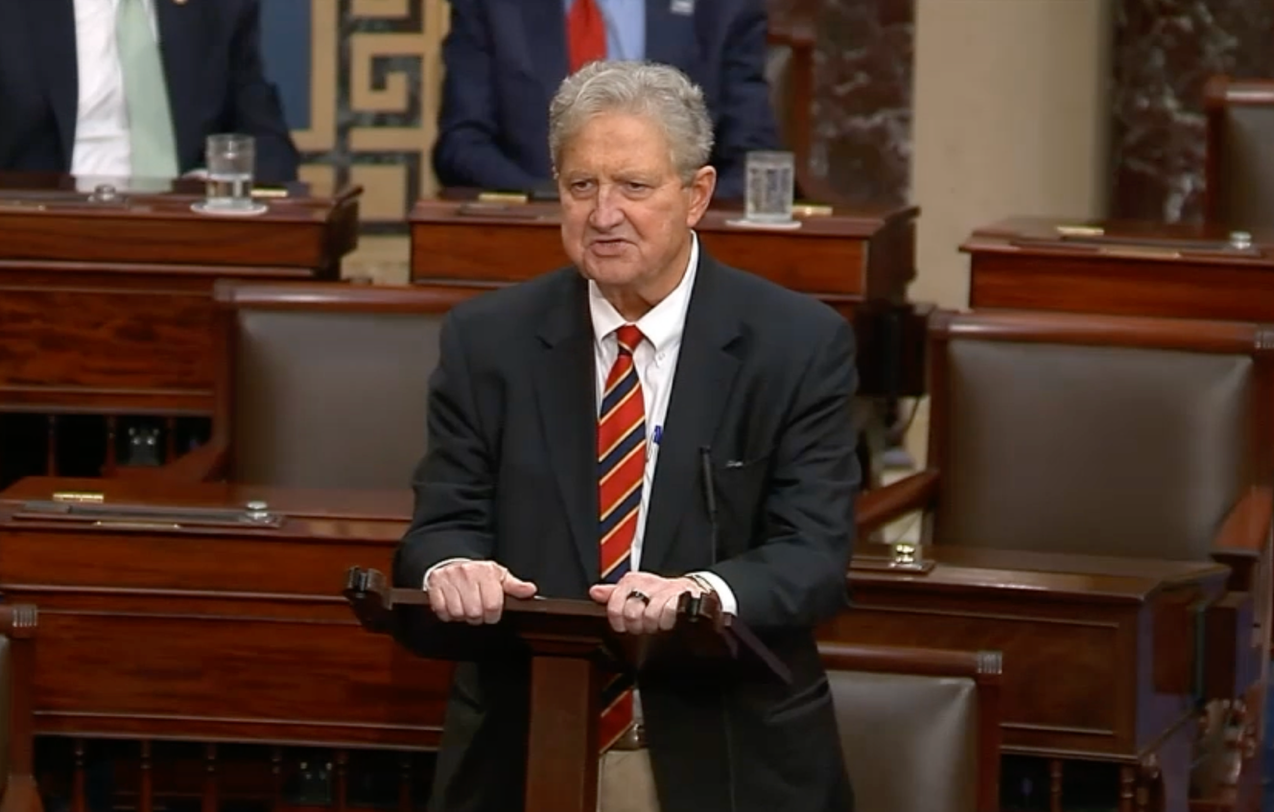
ALEXANDRIA, La. — U.S. Sen. John Kennedy is pointing to $34.5 million in federal funding for military and aviation projects in Central Louisiana as the region looks to build on two of its strongest economic anchors: Fort Polk and England Airpark.
Speaking to the Central Louisiana Regional Chamber of Commerce, Kennedy said the funding includes $30 million for a new Rotational Unit Billeting Area at Fort Polk and $4.5 million for the Aviation Career and Education Initiative at England Airpark in Alexandria.
The Fort Polk project is intended to provide modern housing for troops temporarily stationed at the installation while training at the Joint Readiness Training Center. Kennedy's office described the $30 million as fiscal year 2026 funding. His public appropriations disclosures also identify rotational-unit billeting at Fort Polk as a federal funding priority, underscoring the installation's continuing role in Army readiness and the Central Louisiana economy.
The England Airpark investment is aimed at a different workforce challenge. The $4.5 million Aviation Career and Education, or ACE, initiative will renovate and expand facilities for aviation training, including a new maintenance shop and classrooms designed to prepare future aircraft-maintenance workers and pilots.
Kennedy's FY2026 appropriations disclosures list the England Airpark project at $4.5 million and describe plans to renovate an existing building, demolish part of an old engine-maintenance facility and construct new maintenance and classroom space.
The project fits England Airpark's broader economic-development role. The roughly 4,000-acre complex includes Alexandria International Airport, more than 1.5 million square feet of commercial space and businesses tied to aviation, transportation, manufacturing, education and engineering.
For Central Louisiana, the two investments target industries with an outsized regional impact. Fort Polk and the Joint Readiness Training Center generate military activity and demand for contractors, housing and services, while England Airpark has become a hub for aviation maintenance, industrial operations and workforce development.
Kennedy also used the Chamber appearance to emphasize Louisiana's forestry industry. New LSU AgCenter research estimates the state's forest industry contributed about $14.13 billion to Louisiana's economy in 2024, supported 33,916 jobs and generated roughly $2.46 billion in labor income.
Central and north Louisiana account for much of that activity. The LSU AgCenter found that Louisiana's 4th and 5th congressional districts together contain more than 65 percent of the state's direct forest-industry output and about 63 percent of its direct forest-industry jobs.
Kennedy is an original cosponsor of two measures aimed at the timber sector: the Wildfire Reduction Market Expansion Act and the Emergency Pine Beetle Response Act. His office says the bills are intended to create additional markets for timber removed during wildfire-prevention work and strengthen the response to destructive pine beetle infestations.
Another long-term piece of Central Louisiana's economic strategy is Interstate 14, the proposed Gulf Coast Strategic Highway. The envisioned corridor would run roughly 1,300 miles across the southern United States and connect military installations, freight routes and population centers, including the Alexandria-Pineville area.
Louisiana transportation planning documents have included the I-14/Gulf Coast Strategic Highway system as a statewide transportation priority. Supporters have argued that a completed corridor could improve military mobility, freight movement and economic development across Central Louisiana, although building a multistate interstate of that scale would require years of planning, environmental work and federal and state funding.
Taken together, the Fort Polk, England Airpark, forestry and I-14 initiatives illustrate Central Louisiana's economic position. The region does not depend on a single industry; its growth strategy combines defense, aviation, timber, transportation and workforce development.
The immediate pieces are the two federally funded projects Kennedy highlighted. The larger question is whether Central Louisiana can use those investments to attract additional private employers and build the workforce needed to keep more of the economic activity generated by its military, aviation and natural-resource assets in the region.
Source Notes
U.S. Sen. John Kennedy — FY2026 appropriations disclosures
U.S. Sen. John Kennedy — current appropriations disclosures