Posts filed under Internet

Louisiana Leads Nation in Broadband Buildout as GUMBO 2.0 Reaches Rural Communities

Louisiana is once again finding itself at the front of the pack when it comes to turning federal broadband dollars into actual infrastructure.

Through the state’s GUMBO 2.0 program, Louisiana officials say the state has now delivered two more national firsts in the federal Broadband Equity, Access and Deployment program: the first community in the country to receive BEAD-funded fiber service and the first provider in the nation to begin construction on a BEAD-funded fiber network.

That distinction matters because broadband programs have often been criticized for moving slowly through layers of federal approval, planning and bureaucracy.

Louisiana is now pointing to actual customers, active construction and Louisiana-based companies doing the work.

Pelican Broadband has connected the nation’s first BEAD-funded fiber customers in Coushatta, while SkyRider Communications has begun construction on another federally supported fiber network in northern Louisiana.

Louisiana contractor Etheridge Pipeline & Conduit is also participating in the work.

The projects represent the kind of result taxpayers should expect from major infrastructure spending: completed work, local contractors and measurable service reaching communities that need it.

Rural Louisiana Starts Seeing Results

Coushatta, a small Red River Parish community of roughly 1,750 residents, is now home to the first customers in the country receiving fiber internet through the BEAD program.

Pelican Broadband’s GUMBO 2.0 project includes approximately 100 miles of fiber infrastructure and is expected to bring fiber-to-the-home service to 1,102 locations.

According to ConnectLA, 221 locations are already serviceable.

The full project is expected to be completed by September 2027.

Pelican Broadband President and CEO Mike George said the project fits the company’s long-standing mission of serving rural Louisiana.

“Pelican Broadband has been connecting rural Louisiana since 1948, and this is the same work we have always done — reaching the homes that are hardest to reach,” George said.

The company says the new fiber network will be capable of delivering speeds of up to 10 gigabits per second.

Another Louisiana Company Breaks Ground First

In northern Louisiana, SkyRider Communications has become the first provider in the country to begin construction on a BEAD-funded fiber project.

The company received GUMBO 2.0 funding to serve approximately 700 locations, though the overall project is expected to connect more than 1,000 homes, farms and businesses.

State officials say roughly 80% of the underground duct installation is complete and fiber cable is actively being pulled.

The first customers are expected to come online soon, with the full buildout projected for the first quarter of 2027.

SkyRider President and CEO Brad Warden credited Louisiana’s preparation and early action for allowing the project to move ahead of other states.

“ConnectLA’s leadership made Louisiana number one in the nation for federal BEAD readiness, which empowered us to be the first company in the country to break ground and start building,” Warden said.

Landry: Results Matter More Than Announcements

Gov. Jeff Landry framed the milestone as an example of government funding producing visible, practical results.

“This isn’t about dollars on a spreadsheet; it’s about results that people can see,” Landry said.

“We’re going to be running fiber into rural parishes and putting that work in the hands of Louisiana companies. We’re not just talking about closing the digital divide; we’re actually accomplishing it.”

That is the key distinction.

Government programs are easy to announce. Press conferences, grant awards and promises are common.

What matters is whether infrastructure actually gets built and whether residents actually receive service.

In this case, Louisiana can point to customers already connected and construction crews already working.

Louisiana Continues to Lead BEAD Rollout

According to ConnectLA, Louisiana had already achieved several other firsts in the national BEAD rollout.

The state says it was the first to secure federal approval, the first to distribute BEAD funding and the first to activate a BEAD-funded broadband tower.

Louisiana now adds first fiber customers and first fiber construction to that list.

The state says it remains on track to achieve statewide broadband coverage by 2028.

For rural Louisiana, that could have significant consequences.

Reliable high-speed internet is no longer a luxury. It affects education, small businesses, agriculture, telemedicine, remote work and whether rural communities can compete economically with larger cities.

Louisiana still has a long way to go before every project is completed, and taxpayers should continue watching costs, timelines and performance closely.

But the early results are difficult to ignore.

While other states are still working through the process, Louisiana companies are already putting fiber in the ground and connecting customers.

That is the kind of progress worth recognizing.

Source: Louisiana Office of Broadband Development and Connectivity — ConnectLA
Posted on October 14, 2026 and filed under Internet, Louisiana.

Landry Administration Puts $3.5 Billion Rural Louisiana Push in Focus — Here’s Where the Money Is Going

RUSTON, La. — The Landry administration is putting a combined price tag of more than $3.5 billion on three major initiatives aimed at rural Louisiana, bringing together broadband construction, roads and bridges, and a sweeping new rural health program under one economic-development message.

Gov. Jeff Landry joined officials from ConnectLA, the Office of Louisiana Highway Construction and the Louisiana Department of Health in Ruston to highlight the initiatives, which the administration says are intended to improve the ability of Louisiana residents to live and work in rural communities.

But the $3.5 billion figure is not one new appropriation or a single pool of state money.

It combines several programs with different funding sources, timelines and objectives — including substantial federal funding.

Understanding those differences provides a clearer picture of what Louisiana is actually spending, what has already begun and what remains to be delivered.

More Than $1.5 Billion for Broadband

The largest pieces of Louisiana's rural investment strategy include the state's ongoing broadband buildout.

ConnectLA says Louisiana is deploying more than $1.53 billion in federal broadband funding through programs designed to reach homes and businesses that still lack adequate high-speed internet service.

A major portion comes from the federal Broadband Equity, Access and Deployment program, commonly known as BEAD.

Louisiana received approximately $1.355 billion in BEAD funding through the federal Infrastructure Investment and Jobs Act.

The state has moved unusually quickly in putting that money into projects.

Louisiana became the first state to execute BEAD grant agreements and the first to begin distributing BEAD infrastructure payments to internet providers. Construction is now underway on projects around the state.

The governor's office currently reports that about 93% of Louisiana is served by high-speed internet, compared with 83% when Landry took office. The administration says approximately 450,000 additional Louisiana residents have gained access during that period, supported in part by publicly funded broadband projects.

ConnectLA Executive Director Veneeth Iyengar said the agency expects roughly 95% of Louisiana to have reliable internet access by the end of 2026.

The state's longer-term goal is statewide high-speed internet access by 2028.

ConnectLA also projects approximately $400 million in consumer savings over four years associated with the broadband program.

That estimate, however, is a projection rather than money already returned to Louisiana households.

$580 Million for Roads and Bridges

A second component of the administration's rural investment total is approximately $580 million being advanced through the Office of Louisiana Highway Construction.

According to the administration, 152 road and bridge projects are underway as part of that effort.

The Office of Louisiana Highway Construction was established to oversee and accelerate highway and bridge projects, with an emphasis on project management, procurement, accountability and completing projects more quickly.

Transportation infrastructure can be particularly consequential in rural Louisiana, where deteriorating bridges or highway restrictions can affect agriculture, energy operations, school transportation and industrial development.

The administration argues that improving those connections is therefore an economic-development issue as much as a transportation issue.

Unlike the BEAD broadband allocation, which is principally tied to federal broadband funding, the highway initiative involves strategic use of state infrastructure dollars.

The ultimate measure of the $580 million program will be how many of the identified projects move from construction to completion, along with whether they are delivered within their projected budgets and schedules.

$1.4 Billion Rural Health Transformation

The third major component is Louisiana's Rural Health Transformation Program.

The Louisiana Department of Health says the state received approximately $208.4 million for the program's first year and estimates that Louisiana could receive about $1.4 billion over five years.

The program is supported through the federal Rural Health Transformation Program administered through the Centers for Medicare & Medicaid Services.

Louisiana's application says nearly 1.1 million people — approximately 24% of the state's population — live in rural parishes.

LDH intends to use the program to address access to health care, workforce shortages, health outcomes and the financial sustainability of rural health systems.

Health Secretary Bruce Greenstein described the effort as more than simply an injection of money into existing rural hospitals and clinics.

“We aren’t just investing in rural healthcare; we’re improving how it works,” Greenstein said in the administration's announcement.

Among the challenges identified by LDH are shortages of health-care professionals and the difficulty rural residents can face obtaining specialty and other medical care without traveling significant distances.

The program is designed to operate over several years, meaning the entire $1.4 billion should not be viewed as money already spent in Louisiana.

Why the Administration Is Linking the Programs

Although broadband, highways and health care might appear to be separate issues, the administration is presenting them as parts of the same rural-development problem.

A community attempting to retain residents or attract an employer faces disadvantages if it lacks dependable internet service, adequate transportation infrastructure or reasonable access to medical care.

Landry framed the initiatives around keeping younger Louisiana residents in the communities where they grew up.

“Rural Louisiana has helped build this country and power its industries for generations,” Landry said. “We want our young people across Louisiana to see a future here.”

The administration's argument is that improving basic infrastructure can make rural communities more competitive for businesses while improving quality of life for existing residents.

$3.5 Billion Comes With an Important Asterisk

The administration's combined $3.5 billion figure is substantial, but it requires context.

It should not be interpreted as $3.5 billion in new Louisiana state spending announced this week.

The total combines multiple programs, includes major federal awards and stretches across different implementation periods.

Some projects are already under construction. Others will unfold over several years.

The broadband program, for example, relies heavily on federal BEAD and other federal infrastructure funding. The rural health initiative is also federally supported and is expected to run for five years.

That means the more important question for taxpayers and rural communities will eventually be less about the headline dollar figure and more about measurable results.

How many previously unserved homes actually receive broadband?

How many bridges and roads are completed?

Does rural access to doctors and other medical professionals improve?

And do those investments make it easier for rural communities to retain residents, businesses and jobs?

Those outcomes will determine whether Louisiana's multibillion-dollar rural investment strategy ultimately produces the transformation the administration is promising..

Source Notes

ConnectLA — Louisiana broadband information: https://connect.la.gov/

Louisiana Department of Health — Rural Health Transformation Program: https://ldh.la.gov/

Louisiana Division of Administration: https://www.doa.la.gov/

ConnectLA/Gov. Landry rural investment announcement, October 12, 2026: https://mailchi.mp/la.gov/connectla-emails-10609868

Posted on October 12, 2026 and filed under Internet, Jeff Landry, Louisiana.

Louisiana Ranks Fourth Nationally in Broadband Expansion as 52,000 More Homes and Businesses Gain Access

Louisiana is making measurable progress in expanding high-speed internet access, with more than 52,000 additional homes and businesses gaining access to broadband during the second half of 2025.

According to the Louisiana Office of Broadband Development and Connectivity, known as ConnectLA, newly released Federal Communications Commission data show the number of locations served statewide increased by 3.16% over the six-month period.

That placed Louisiana fourth nationally in proportional growth, compared with a national average of 0.9%.

For Louisiana communities that have struggled with unreliable internet service, the expansion represents more than another economic-development statistic.

It means additional households and businesses can access services that have become essential to modern life.

Why Broadband Matters Beyond the Cities

For years, many rural Louisiana residents have faced limited choices when it comes to internet service.

Some households have relied on fixed wireless connections, satellite service or mobile hotspots because traditional high-speed connections were unavailable.

That can create challenges for students completing schoolwork, employees working remotely, patients using telehealth services and small businesses trying to compete online.

Reliable broadband can also affect whether a family chooses to live in a particular community or whether a business can operate efficiently outside a major population center.

Expanding service into underserved areas gives residents additional options without requiring them to relocate.

A Louisiana Resident Sees the Difference

ConnectLA highlighted the experience of Lance Milligan, a resident of Dixie Inn, who previously relied on two separate fixed wireless connections to meet his household's internet needs.

After fiber service became available through Louisiana's GUMBO 1.0 broadband program, Milligan switched to a single gigabit connection.

According to ConnectLA, the new service provides faster and more reliable connectivity at a lower monthly cost than his previous arrangement.

His experience illustrates the potential benefits of expanding broadband infrastructure into communities where residents have historically had limited service options.

What This Means for Louisiana's Economy

Louisiana is pursuing major investments in aerospace, advanced manufacturing, energy, technology and other industries.

But economic development is not limited to the communities hosting billion-dollar projects.

Smaller towns and rural parishes also need the infrastructure that allows residents and businesses to participate in a modern economy.

A reliable internet connection can help a local contractor submit bids, allow a small business to reach customers outside its immediate community and give residents access to educational and professional opportunities that might otherwise require traveling long distances.

Broadband expansion is particularly important for communities seeking to retain younger residents and attract new businesses.

The availability of high-speed internet does not guarantee economic growth, but limited connectivity can make it harder for communities to compete.

The Work Is Not Finished

Louisiana's fourth-place ranking measures the percentage increase in locations with broadband available during the reporting period.

It does not mean Louisiana has the nation's fourth-highest overall broadband coverage, nor does it establish that every newly served household has subscribed to the service.

Affordability, reliability and the availability of service in the state's most difficult-to-reach communities remain important questions.

The latest figures nevertheless show that Louisiana is making progress in expanding the infrastructure needed to connect more residents and businesses.

For the 52,000-plus additional locations where broadband became available, that progress is becoming something tangible: another option for connecting to the rest of the world.

And for Louisiana's rural communities, that connection can make a meaningful difference.

Source: Louisiana Office of Broadband Development and Connectivity (ConnectLA) .

Posted on September 22, 2026 and filed under Internet, Louisiana.

Louisiana set to achieve statewide high-speed internet access by 2028, outpacing the federal 2030 goal

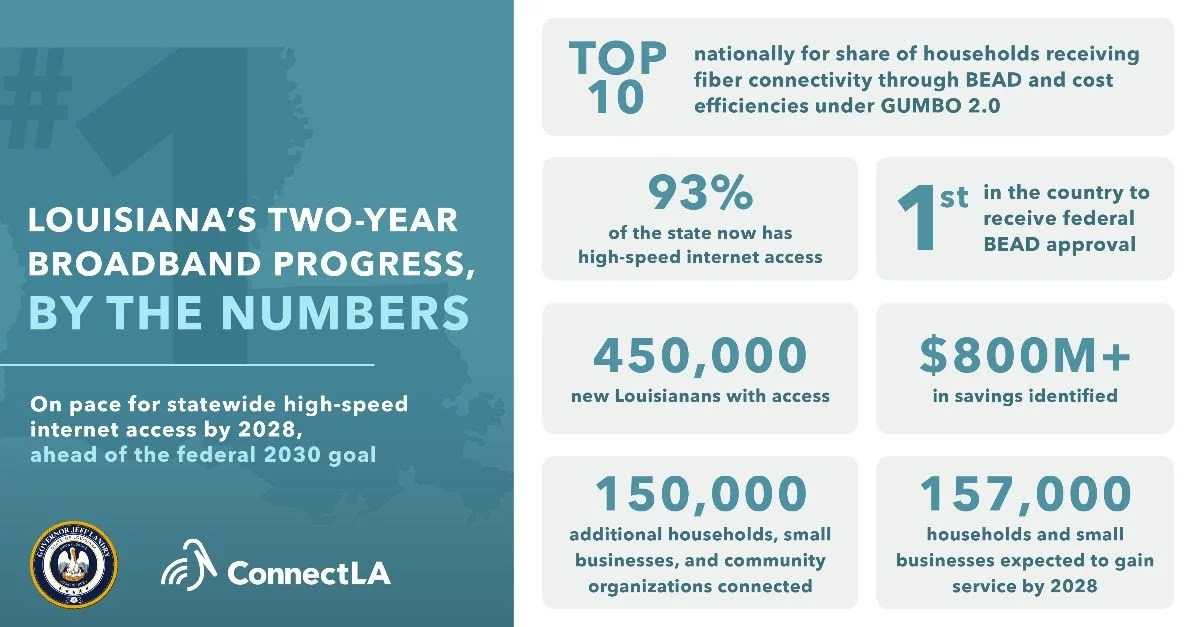
Roughly 450,000 Louisianans, enough to fill Tiger Stadium more than four times, have received access in just two years.

Gov. Jeff Landry announced today that Louisiana is significantly ahead of schedule in its effort to provide high-speed internet access to every Louisiana resident.


Since the beginning of the Landry Administration, more than 150,000 additional households, small businesses, and community organizations have received access. This growth has been achieved through private investment and federal funds put to work by Louisiana’s internet service providers, with most new service delivered through fiber.

“When I took office, about 83% of our state had access to high-speed internet. Today we’re approaching 93%. That’s nearly 450,000 people, more than four Tiger Stadiums full, who now have the tools they need to work, learn, and compete. We got here by listening to residents, focusing on results, and keeping the work moving, and we’re going to keep pushing until every family in this state has the same kind of reliable access.”

Gov. Jeff Landry

Louisiana’s broadband progress has earned significant national attention. The state became the first in the country to receive full federal approval of its BEAD plan and now ranks among the top 10 states for the percentage of households receiving fiber connectivity through BEAD, as well as the cost efficiencies achieved under the GUMBO 2.0 program. In total, Louisiana identified more than $800 million in savings, with federal guidance on their use expected by March 2026.

“This work is delivering real value to taxpayers. We are stretching every dollar and moving faster than Washington ever expected.”

Gov. Jeff Landry

Over the past several weeks, representatives from the governor’s office and ConnectLA have joined local leaders and internet providers to celebrate completed broadband projects in Vernon, Vermilion, and Acadia parishes, where Gumbo 1.0 investments have provided access to thousands of homes and hundreds of small businesses. More ribbon cuttings are planned for completed projects in Allen, Grant, LaSalle, Avoyelles, and other parishes, along with groundbreaking ceremonies for new construction made possible through federal BEAD funding.


Early 2026 is expected to bring the most significant broadband construction activity Louisiana has ever undertaken. Projects entering the ground phase will connect more than 127,000 new households and bring service to another 30,000 households through the completion of GUMBO 1.0 work already underway.

“These wins show up in real places, not spreadsheets. They’re the farms, the classrooms, and the small businesses that finally have the infrastructure they’ve waited on for years. With this momentum, Louisiana is on pace to reach full high-speed internet access in 2028, if not sooner. That’s two years at minimum before the federal goal. And we’re not slowing down.”

Veneeth Iyengar
Executive Director of ConnectLA

Visit the ConnectLA website to learn more

Posted on December 18, 2025 and filed under Internet, Jeff Landry, Louisiana.

Letter: Conservatives in Louisiana Support KOSA

Photo source: The Hilltopper

As a parent, I am deeply concerned about the growing risks they face online, and that’s why I joined over 20 other Louisianans to support the Kids Online Safety Act through the petition below.  This critical legislation takes important steps to hold tech companies accountable for the safety of young users, providing stronger protections against harmful content, cyberbullying, and online predators.

Conservatives for KOSA

In today’s digital age, children are increasingly exposed to dangers that can harm their mental and emotional well-being. Social media platforms and other online services often fail to properly protect young users from inappropriate or harmful material, and many are designed to keep kids engaged for longer periods, which can have negative consequences on their health. KOSA prioritizes transparency from online platforms and gives parents the tools they need to better protect their children. I believe this bill is an essential step in ensuring that our kids can safely navigate the internet without being exposed to the many harmful elements that exist online.

As a parent, I want to feel confident that the platforms my children use are not only fun and educational but also safe and responsible. The Kids Online Safety Act offers a much-needed solution by implementing age-appropriate safeguards and giving parents more control over their children’s online experiences. I believe that protecting children’s safety online is a responsibility we all share, and I urge our lawmakers to take swift action in passing KOSA to safeguard the future of our children and families.

Kathy Willard

Posted on December 17, 2024 and filed under Internet.